
ACT vs SAT: which test should your teen take?
Global TutorsOctober 20, 2026
ACT describes the ACT and the SAT as the two most widely recognized standardized tests used in US college admissions, and both are open to international students. They test similar skills but are built differently: one is shorter, one is adaptive, one has an optional science section, and the two use different scales. This guide compares them using what the test makers themselves publish, then explains how to choose.
ACT vs SAT at a glance
The SAT (College Board) has two sections:
- Reading and Writing: 54 questions in two 32-minute modules, 64 minutes in total.
- Math: 44 questions in two 35-minute modules, 70 minutes in total.
- Total: 98 questions in 2 hours 14 minutes, with a 10-minute break between the sections.
The ACT (ACT, Inc.) has three core tests and two optional ones:
- English: 50 questions in 35 minutes.
- Math: 45 questions in 50 minutes.
- Reading: 36 questions in 40 minutes.
- Science (optional): 40 questions in 40 minutes.
- Writing (optional): one essay in 40 minutes.
The core ACT takes 2 hours 5 minutes. Each optional section adds 40 minutes.
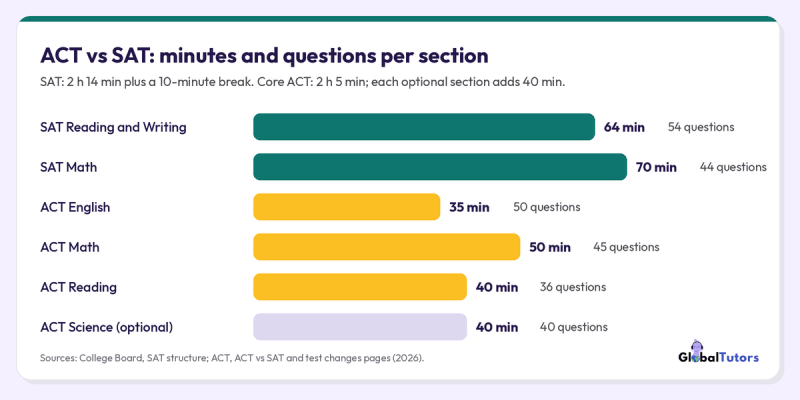
Measured per question, the SAT gives more time than the ACT in both of its sections.
How the two tests are scored
SAT: a total score from 400 to 1600, made up of a Reading and Writing score and a Math score, each from 200 to 800.
ACT: each test is scored from 1 to 36. The Composite score is the average of English, Math and Reading, rounded to the nearest whole number, with halves rounded up. Science and Writing are reported separately and don't affect the Composite. ACT began phasing Science out of the Composite for national online testing in April 2025, and from September 2025 every ACT test used the new calculation. ACT scores are based on the number of correct answers, and there's no penalty for a wrong answer.
The two scales can be compared using the official ACT/SAT concordance tables. ACT gives one example: an ACT score of 30 is roughly equivalent to an SAT score of about 1370. These are estimates, not exact conversions.
The differences that matter in practice
Adaptive vs linear. On the SAT, the first module of each section has a mix of easy, medium and hard questions. Depending on how a student does, the second module is either harder or easier. The ACT isn't adaptive: there's no second module that changes with performance, and each section is a single timed section.
Time per question. You can work this out from the official timings:
- SAT Reading and Writing: 64 minutes for 54 questions, about 71 seconds per question.
- SAT Math: 70 minutes for 44 questions, about 95 seconds per question.
- ACT English: 35 minutes for 50 questions, 42 seconds per question.
- ACT Math: 50 minutes for 45 questions, about 67 seconds per question.
- ACT Reading: 40 minutes for 36 questions, about 67 seconds per question.
If your child reads and decides quickly, the ACT's pace may suit them. If they need more time on each problem, the SAT gives more of it.
Calculators. On the SAT, a calculator is allowed for the whole Math section. The Desmos calculator is built into the Bluebook testing app, or students can bring an approved handheld calculator. CAS calculators aren't allowed, and no calculator may be used in Reading and Writing. On the ACT, a permitted calculator can be used on the math test only. A built-in calculator is also available for online testing at a test center.
Format. The SAT is digital and taken in Bluebook. The ACT is offered on paper or online in the US. For students outside the US, ACT says the test is only available online, at a test center on a test center-managed device, not at home.
Science. The SAT has no science section. On the ACT, Science is optional. Taking it adds a Science score and a STEM score (the average of math and science).
2026-27 test dates
SAT Weekend dates for the rest of the 2026-27 year apply to US and international students alike:
- November 7, 2026 (register by October 23)
- December 5, 2026 (register by November 20)
- March 6, 2027 (register by February 19)
- May 1, 2027 (register by April 16)
- June 5, 2027 (register by May 21)
ACT national test dates (for the US, US territories and Puerto Rico):
- December 12, 2026 (register by November 6)
- February 27, 2027 (register by January 22)
- April 10, 2027 (register by March 5)
- June 12, 2027 (register by May 7)
- July 10, 2027 (register by June 4)
ACT's late fee applies after each registration deadline. ACT says most scores are released about 2 to 4 weeks after the test.
How to choose between the ACT and SAT
- Take one official full-length practice test of each. The College Board offers full-length SAT practice tests in Bluebook, and ACT offers free practice tests. Take them under timed conditions.
- Compare the results using the concordance tables, not the raw numbers.
- Look at which sections cost the most points. If the clock was the problem on the ACT, the SAT's longer time per question may help. If the adaptive second module felt stressful, the ACT's fixed format may suit your child better.
- Look up each college's testing policy and typical scores. ACT advises researching the average scores at your target colleges to set a goal.
- Commit to one test and prepare properly. ACT advises that sending both scores usually doesn't give an advantage, and that focusing on one test lets students put all their practice into it.
FAQ
Is the ACT or SAT shorter?
The core ACT is 2 hours 5 minutes. The SAT is 2 hours 14 minutes of testing plus a 10-minute break. The ACT gets longer if your child adds Science or Writing.
Do colleges prefer the ACT or the SAT?
ACT states that both tests are equally accepted and considered at all accredited US colleges and universities, including the Ivy League.
Can my child use a calculator on the whole test?
On the SAT, yes for the whole Math section, but not for Reading and Writing. On the ACT, only on the math test.
Can international students take the ACT on paper?
No. ACT says the test is only available online for students outside the US, at a test center.
What is an ACT Superscore?
It's the average of a student's highest English, Math and Reading scores across all their ACT test dates. ACT says many colleges accept Superscores.
Prepare with an SAT or ACT tutor
Our 124 tutors include 16 with examiner, marker or moderator experience, and 51% hold a teaching qualification. We'll match you with a tutor within a day, starting with a free, no-obligation Meet & Greet. There's no long-term contract.
Find an SAT tutor | ACT test prep | SAT and ACT tutoring
Sources
- College Board, How the SAT Is Structured: https://satsuite.collegeboard.org/sat/whats-on-the-test/structure
- College Board, SAT Suite test dates and deadlines: https://satsuite.collegeboard.org/sat/dates-deadlines
- College Board, What do my SAT Suite scores mean: https://satsuite.collegeboard.org/sat/scores/understanding-scores
- College Board, SAT Suite calculator policy: https://satsuite.collegeboard.org/in-school-assessments/calculator-policy
- College Board, SAT practice tests: https://satsuite.collegeboard.org/practice/practice-tests
- ACT, ACT vs SAT: https://www.act.org/content/act/en/products-and-services/the-act/scores/act-vs-sat.html
- ACT, Understanding your scores (Composite, Science change, concordance example, Superscore): https://www.act.org/content/act/en/products-and-services/the-act/scores/understanding-your-scores.html
- ACT, Test dates and deadlines: https://www.act.org/content/act/en/products-and-services/the-act/registration/test-dates.html
- ACT, Online testing (international testing, calculators): https://www.act.org/content/act/en/products-and-services/the-act/test-changes.html
- ACT, Free test prep: https://www.act.org/content/act/en/products-and-services/the-act/test-preparation/free-act-test-prep.html
Ready to excel in your exams?
Get personalized support from our expert tutors and achieve your academic goals.