
IB Diploma points: how the 45-point score works
Global TutorsOctober 19, 2026
The IB Diploma is scored out of 45 points, and a student needs at least 24 to be awarded it. But 24 points isn't enough on its own. The IB also sets conditions on HL and SL totals, low grades and the core, and missing any one of them means no diploma, whatever the total. This guide explains where the points come from and what those conditions are, with two worked examples.
Where IB Diploma points come from
A diploma student takes six subjects plus the DP core: theory of knowledge (TOK), the extended essay (EE) and creativity, activity, service (CAS).
- Six subjects, graded 1 to 7. Each grade counts as the same number of points, so a 6 is worth 6 points. That gives a maximum of 42.
- The core, worth up to 3 points. TOK and the EE are each graded A to E, and the two grades are combined in the IB's core points matrix.
- CAS earns no points, but it must be completed for the diploma to be awarded.
So the maximum is 6 × 7 + 3 = 45. The IB awards the same points for higher level (HL) and standard level (SL) subjects. HL covers more content (240 recommended teaching hours against 150 at SL), but a 6 is a 6 at either level.
The core points matrix
The TOK and EE grades are combined like this:
- EE A: with TOK A, 3 points; TOK B, 3; TOK C, 2; TOK D, 2.
- EE B: with TOK A, 3 points; TOK B, 2; TOK C, 2; TOK D, 1.
- EE C: with TOK A, 2 points; TOK B, 2; TOK C, 1; TOK D, 0.
- EE D: with TOK A, 2 points; TOK B, 1; TOK C, 0; TOK D, 0.
- An E in either TOK or the EE is a failing condition. No diploma is awarded, whatever the other grade.
The IB's own example: a B in TOK and a C in the EE earns 2 points.
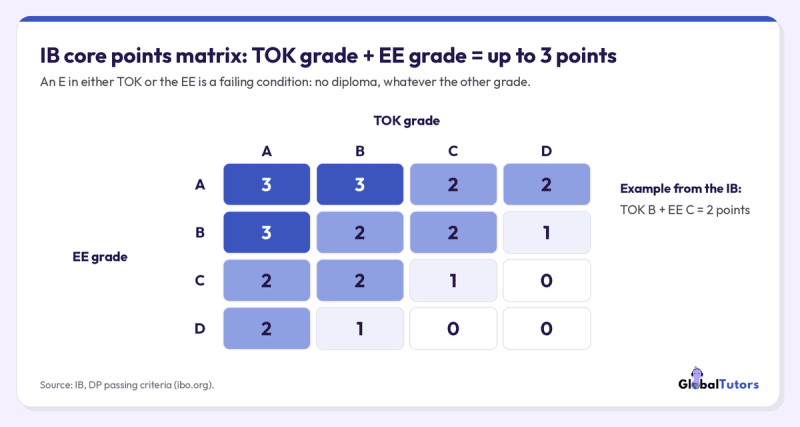
An A in one component with a D in the other earns 2 points, the same as a B in both.
The 24-point minimum and the conditions
According to the IB, a candidate only receives the diploma if all of these are true:
- CAS requirements have been met.
- They have at least 24 points in total.
- A grade has been awarded in every subject, TOK and the EE.
- Every subject grade is at least a 2.
- There are no more than two grade 2s (SL or HL).
- There are no more than three grades of 3 or below (SL or HL).
- They have at least 12 points across their HL subjects. For students registered for four HL subjects, the three highest grades count.
- They have at least 9 points across their SL subjects. Students registered for two SL subjects need at least 5 points at SL.
Condition 3 matters more than it looks. An "N" against a subject means the IB couldn't award a grade because not all the requirements were met, and without a grade in every subject, TOK and the EE, there's no diploma.
The IB puts it plainly: "a student with a total score far exceeding 24 points may not necessarily be awarded the diploma."
Two worked examples
Example 1: diploma awarded. HL grades 6, 5 and 5; SL grades 5, 4 and 4; TOK B and EE C.
- Subject points: 6 + 5 + 5 + 5 + 4 + 4 = 29.
- Core points: TOK B with EE C = 2.
- Total: 29 + 2 = 31, which is at least 24.
- HL total: 16, which is at least 12. SL total: 13, which is at least 9.
- No grade 1 or 2, and no grade of 3 or below.
Every condition is met, so the diploma is awarded with 31 points.
Example 2: 26 points, no diploma. HL grades 4, 4 and 3; SL grades 5, 5 and 4; TOK C and EE C.
- Subject points: 4 + 4 + 3 + 5 + 5 + 4 = 25.
- Core points: TOK C with EE C = 1.
- Total: 26, which is above 24.
- HL total: 4 + 4 + 3 = 11, which is below 12.
The HL condition fails, so the diploma isn't awarded, even though the total is above the minimum. The student receives DP Course Results instead, which list their grade in each subject.
What this means for planning
The rules point to some practical habits:
- Watch the HL total, not only the overall score. Three HL subjects at 4 give exactly 12. A single 3 at HL means the other two must make up the gap.
- Protect TOK and the EE. An E in either ends the diploma, and together they're worth up to 3 points. Moving from C/C (1 point) to B/B (2 points) is worth as much as raising a subject grade by one.
- Track low grades across all six subjects. One grade 1 fails the diploma, and so do three 2s or four grades of 3 or below.
- Keep CAS up to date. It earns no points, but the diploma can't be awarded without it.
- Know what universities ask for. The IB says many universities use a 4 or a 5 in a subject as the minimum for granting admission or advanced placement, and its general regulations leave students and families responsible for checking each university's entry requirements.
What happens if the diploma isn't awarded
A student who doesn't meet the requirements receives DP Course Results, showing the grades they earned in each subject and in TOK and the EE. The IB says that whether a student who didn't earn the diploma can go to a particular university depends on that university's admission requirements.
The IB removed its "three-session rule" in 2023, so students are no longer limited to three exam sessions to meet the diploma requirements. A student can retake a subject in a future exam session, at any IB World School that offers the Diploma Programme and agrees to accept them. Schools are under no obligation to accept retake candidates. According to the IB's general regulations, the highest grade for a retaken subject counts towards the diploma.
FAQ
What is the passing score for the IB Diploma?
24 points out of 45, provided all the other conditions are met.
Is there a passing grade for a single IB subject?
No. The IB says it doesn't assign passing scores for individual courses. A student simply receives a grade from 1 to 7.
Do HL subjects earn more points than SL?
No. Each subject earns 1 to 7 points at either level, but there are separate minimum totals for HL (12) and SL (9).
How many points do TOK and the EE add?
Between 0 and 3, from the core points matrix. An E in either is a failing condition.
Can a student with 30 points fail the diploma?
Yes, if they miss any condition, such as an E in TOK, a grade 1 in a subject, fewer than 12 HL points or incomplete CAS.
Raise the grades that decide the diploma
Our 124 tutors include 16 with examiner, marker or moderator experience, and 51% hold a teaching qualification. An IB tutor can help your child target the subjects and core components where a grade gain matters most. We'll match you with a tutor within a day, starting with a free, no-obligation Meet & Greet. There's no long-term contract.
Find an IB Diploma tutor | IB TOK tutoring | IB Extended Essay tutoring | The IB Diploma Programme explained
Sources
- IB, DP passing criteria (points, core matrix, conditions): https://www.ibo.org/about-the-ib/what-it-means-to-be-an-ib-student/recognizing-student-achievement/about-assessment/dp-passing-criteria/
- IB, Understanding DP assessment: https://www.ibo.org/programmes/diploma-programme/assessment-and-exams/understanding-ib-assessment/
- IB, Assessment FAQ (course results, passing course scores, retakes, three-session rule): https://ibo.org/programmes/diploma-programme/assessment-and-exams/getting-results/assessment-faq/
- IB, General regulations: Diploma Programme, for the May and November 2026 sessions (retakes, DP Course Results, university entry requirements): https://www-prod.ibo.org/globalassets/new-structure/become-an-ib-school/pdfs/dp-2026-general-regulations.pdf
- IB, DP curriculum (HL 240 and SL 150 teaching hours): https://www.ibo.org/programmes/diploma-programme/curriculum/
Ready to excel in your exams?
Get personalized support from our expert tutors and achieve your academic goals.