IGCSE Maths 0580 formula sheet: what's given and what to learn
Global TutorsOctober 29, 2026
Cambridge IGCSE Mathematics (0580) papers include a List of formulas on page 2 of every exam paper. Candidates can refer to it during the exam, but it doesn't contain every formula they need. This guide sets out exactly what the list gives at Core and at Extended, the formulas the syllabus says students must know, and how to use the list well. It is based on the 0580 syllabus for examination in 2025, 2026 and 2027.
How the 0580 exams are set up
The 0580 syllabus has two tiers, and every candidate takes two papers:
- Core: Paper 1 (non-calculator) and Paper 3 (calculator), each 1 hour 30 minutes, 80 marks and 50% of the qualification. Core candidates are eligible for grades C to G.
- Extended: Paper 2 (non-calculator) and Paper 4 (calculator), each 2 hours, 100 marks and 50%. Extended candidates are eligible for grades A* to E.
Calculators are not allowed in Papers 1 and 2. A scientific calculator is required for Papers 3 and 4. The List of formulas appears on page 2 of all four papers, so it is there in the non-calculator papers too.
What the IGCSE Maths 0580 formula sheet gives
The syllabus prints the full List of formulas for each tier.
Core (Papers 1 and 3) and Extended (Papers 2 and 4) both give:
- area of a triangle, A = 1/2 bh
- area of a circle, A = πr²
- circumference of a circle, C = 2πr
- curved surface area of a cylinder, A = 2πrh
- curved surface area of a cone, A = πrl (l is the sloping edge)
- surface area of a sphere, A = 4πr²
- volume of a prism, V = Al (A is the cross-sectional area)
- volume of a pyramid, V = 1/3 Ah
- volume of a cylinder, V = πr²h
- volume of a cone, V = 1/3 πr²h
- volume of a sphere, V = 4/3 πr³.
Extended papers also give:
- the quadratic formula, x = (-b ± √(b² - 4ac)) / 2a, for ax² + bx + c = 0 where a ≠ 0
- the sine rule, a/sin A = b/sin B = c/sin C
- the cosine rule, a² = b² + c² - 2bc cos A
- the area of a triangle, Area = 1/2 ab sin C.
The chart below sets out the two lists side by side.
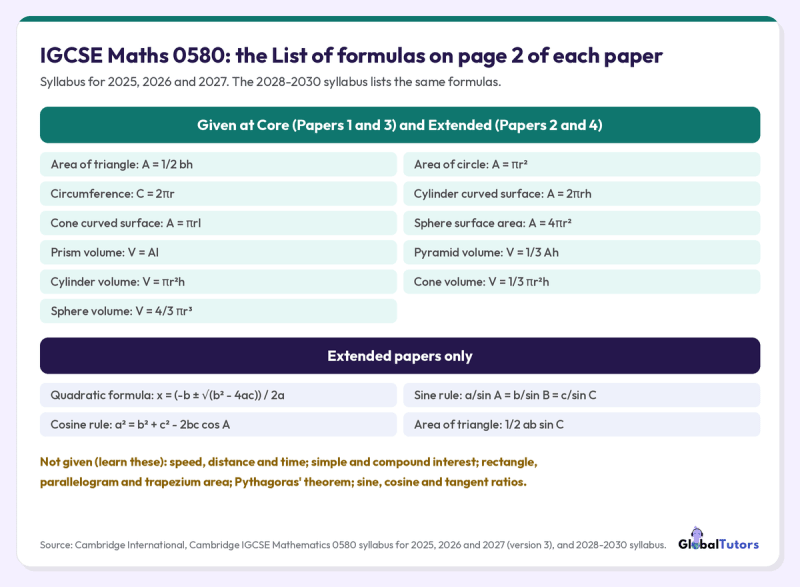
The List of formulas in the 0580 syllabus for 2028, 2029 and 2030 gives the same formulas for each tier.
Formulas you must learn
The syllabus says that not all required formulas are given, and its notes column says where a formula is not given. From those notes, these must be learned:
- Speed, distance and time. Knowledge of the speed, distance and time formula is required.
- Simple and compound interest. The formulas are not given, and problems may include repeated percentage change.
- Area and perimeter of a rectangle, parallelogram and trapezium. Except for the area of a triangle, these formulas are not given.
- Pythagoras' theorem and right-angled trigonometry. The syllabus asks students to know and use Pythagoras' theorem and the sine, cosine and tangent ratios. They are not in the list.
For other measures of rate, such as pressure, density and population density, the syllabus says the required formulas will be given in the question.
The list also leaves out work that builds on the given formulas. Arc length and sector area are calculated as fractions of the circumference and area of a circle, and compound shapes and solids, such as a frustum, are worked out from their parts.
A worked example: using given and learned formulas together
A cone has base radius 3 cm and height 4 cm. Find its volume and its curved surface area.
The volume formula is given: V = 1/3 πr²h = 1/3 x π x 3² x 4 = 12π, which is 37.7 cm³ to 3 significant figures.
The curved surface area formula, A = πrl, is also given, but it needs the sloping edge l, which is not. Pythagoras' theorem, which has to be learned, gives l = √(3² + 4²) = √25 = 5 cm. Then A = π x 3 x 5 = 15π, which is 47.1 cm² to 3 significant figures.
On Paper 2 or Paper 4, answers may be asked for in terms of π, so 12π cm³ and 15π cm² may be the final answers. On the calculator papers (Papers 3 and 4), the syllabus asks for non-exact answers to 3 significant figures (or 1 decimal place for angles in degrees) unless the question says otherwise, and says to use the calculator value of π or 3.142.
A second example uses a formula that isn't given. A deposit of $2,000 earns compound interest at 3% a year for 4 years. The value is 2000 x 1.03⁴ = $2,251.02, so the interest earned is $251.02.
How to use the formula sheet in the exam
- Know what is on page 2 before the exam. Read the list for your tier so you know which formulas you can look up and which you must recall.
- Learn the missing ones by heart. Speed, distance and time; simple and compound interest; the trapezium and parallelogram; Pythagoras' theorem; and sine, cosine and tangent.
- Write the formula first. Copy the formula from the list, then substitute. It keeps your working clear.
- Avoid rounding too early. For Papers 3 and 4, the syllabus says that to earn accuracy marks, candidates should avoid rounding until the final answer, and use the unrounded value in later parts.
- Practise without a calculator. Papers 1 and 2 are non-calculator, so practise leaving answers in terms of π and working with exact values.
- Practise with official papers. Cambridge International publishes past papers, examiner reports and specimen papers, so practise with papers for your tier.
For papers to practise with, see our guide to Cambridge IGCSE Mathematics 0580 past papers. If you are unsure which tier to enter, read Cambridge IGCSE grading: the A*-G scale and Core vs Extended. Students moving on to more algebra can read our IGCSE Additional Maths 0606 guide, and the Cambridge hub covers the wider programme.
FAQ
Is there a formula sheet in IGCSE Maths 0580?
Yes. A List of formulas is included on page 2 of every 0580 exam paper, at both Core and Extended.
Is the quadratic formula given in IGCSE Maths?
Yes, on the Extended papers (Papers 2 and 4). It is not on the Core list.
Are the sine and cosine rules given?
Yes, on the Extended papers, along with the formula Area = 1/2 ab sin C.
Is Pythagoras' theorem on the 0580 formula sheet?
No. The syllabus asks students to know and use Pythagoras' theorem, and it isn't in the List of formulas.
Do I need to learn the compound interest formula?
Yes. The syllabus says the simple and compound interest formulas are not given.
Get help with IGCSE Maths
Global Tutors works with families worldwide, including Cambridge IGCSE students. Of our 124 tutors, 16 have examiner, marker or moderator experience, and 51% hold a teaching qualification. Ask for a tutor with examiner, marker or moderator experience. We match you with a tutor within a day, starting with a free Meet & Greet, and there are no ongoing contracts.
Find an IGCSE Maths tutor | Cambridge IGCSE tutoring
Sources
- Cambridge International, Cambridge IGCSE Mathematics (0580) syllabus page: https://www.cambridgeinternational.org/programmes-and-qualifications/cambridge-igcse-mathematics-0580/
- Cambridge International, Cambridge IGCSE Mathematics 0580 syllabus for 2025, 2026 and 2027 (version 3): https://www.cambridgeinternational.org/Images/662466-2025-2027-syllabus.pdf
- Cambridge International, Cambridge IGCSE Mathematics 0580 syllabus for 2028, 2029 and 2030: https://www.cambridgeinternational.org/Images/745681-2028-2030-syllabus.pdf
Related Cambridge tutoring
Find 1-to-1 tutoring for Cambridge IGCSE and A Level.
Ready to excel in your exams?
Get personalized support from our expert tutors and achieve your academic goals.