
IGCSE to IB: what changes when you start the IB Diploma
Global TutorsOctober 12, 2026
Cambridge IGCSE covers ages 14 to 16, and the IB Diploma Programme (DP) is designed for ages 16 to 19, so the two fit in sequence. The jump isn't only harder content. The structure of study, the way students are assessed and the grading scale all change. This guide sets out what's different, using what Cambridge and the IB publish, and how to prepare for the move from IGCSE to IB.
IGCSE and the IB Diploma at a glance
Cambridge IGCSE is, according to Cambridge, the world's most popular international qualification for 14 to 16 year olds. Students choose from over 70 subjects in any combination. Assessment takes place at the end of the course and includes written, oral, coursework and practical assessment. Cambridge designs each IGCSE syllabus to require about 130 guided learning hours.
The IB Diploma Programme is designed for students aged 16 to 19 and is taught in the last two years of secondary school. It's a single, connected programme: six subjects plus a required core, studied together over two years.
What changes from IGCSE to IB
1. From free choice to a structured set of six subjects
At IGCSE, subjects can be taken in any combination. In the DP, a student must take at least one subject from each of five groups:
- language and literature
- language acquisition
- individuals and societies
- sciences
- mathematics
The sixth subject is from the arts or, instead, an additional sciences, individuals and societies or languages subject. That means every diploma student keeps studying a language, a science, a humanities subject and maths to the end of school.
2. Higher level and standard level
Each DP student takes three or four subjects at higher level (HL) and the rest at standard level (SL). The IB gives HL subjects 240 recommended teaching hours and SL subjects 150. HL and SL differ in scope but are assessed against the same grade descriptors.
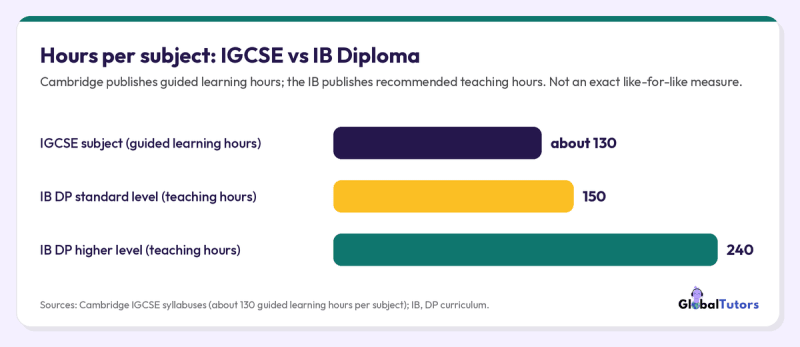
Cambridge's 130 hours are guided learning hours, and the IB's figures are recommended teaching hours, so they aren't an exact like-for-like measure. In raw numbers, 240 is nearly double 130.
3. A required core
On top of six subjects, the IB Diploma has three core requirements:
- The extended essay (EE): an independent, self-directed piece of research, finishing with a 4,000-word paper. It's mandatory for all diploma students.
- Theory of knowledge (TOK).
- Creativity, activity, service (CAS).
TOK and the EE together can add up to 3 points to the diploma score. CAS earns no points, but it must be completed for the diploma to be awarded.
4. A different grading scale
DP subjects are graded from 7 to 1, with 7 the highest. The diploma total is out of 45, and a student needs at least 24 points, plus the IB's other conditions, to be awarded the diploma. That's a different system from IGCSE grades, so read DP grades against the IB's 1 to 7 scale, not against IGCSE letters.
5. Maths: one course, chosen early
The IB offers two maths courses, Mathematics: analysis and approaches (AA) and Mathematics: applications and interpretation (AI), each at SL and HL. A student can only study one maths course as part of the diploma, and every DP maths course requires students to become proficient with graphic display calculators. The IB will teach a new curriculum for both courses from 2027, with first assessment in 2029.
How to choose HL subjects after IGCSE
These questions help when turning IGCSE results into DP choices:
- Which subjects does your child enjoy enough for 240 hours? HL is a large commitment, and three or four of them is the minimum.
- What do the universities they're considering ask for? The IB says students and families are responsible for checking universities' entry requirements, and many universities use a subject grade of 4 or 5 as a minimum for admission or advanced placement.
- Which maths course fits? AA and AI suit different students, and only one can be taken.
- What does the school offer? Subject availability and timetable combinations vary from school to school.
How to prepare for the move from IGCSE to IB
- Close any gaps from IGCSE. DP courses build on earlier study, so use the time before the programme starts.
- Build independent study habits. The EE is independent, self-directed research, and most subjects also include in-school assessment tasks alongside the final exams.
- Practise extended writing. The EE finishes with a 4,000-word paper, and TOK is assessed partly through an essay.
- Get comfortable with a graphic display calculator. It's required in every DP maths course.
- Plan the two years. Six subjects, the EE, TOK and CAS all run together, so time management matters from the first term.
FAQ
Is IGCSE good preparation for the IB Diploma?
IGCSE is designed for ages 14 to 16 and the DP for ages 16 to 19, so the two fit in sequence.
How many subjects do you take in the IB compared with IGCSE?
IGCSE has no fixed number: students choose from over 70 subjects in any combination. The IB Diploma requires six subjects plus the core.
Can you take both maths courses in the IB?
No. Students can only study one course in mathematics as part of the diploma.
What's the minimum score for the IB Diploma?
24 points out of 45, provided the other conditions are met.
Is the extended essay compulsory?
Yes. It's mandatory for all IB Diploma students and finishes with a 4,000-word paper.
Make the move from IGCSE to IB with support
Our 124 tutors include 16 with examiner, marker or moderator experience, and 51% hold a teaching qualification. A tutor can close IGCSE gaps and prepare your child for HL subjects, the EE and TOK. We'll match you with a tutor within a day, starting with a free, no-obligation Meet & Greet. There's no long-term contract.
IB Diploma tutoring | IGCSE tutoring | The IB Diploma Programme explained
Sources
- Cambridge International, Cambridge IGCSE (most popular qualification for 14 to 16 year olds, over 70 subjects, assessment types): https://www.cambridgeinternational.org/programmes-and-qualifications/cambridge-upper-secondary/cambridge-igcse/
- Cambridge International, Cambridge IGCSE Chemistry 0620 syllabus for 2026, 2027 and 2028 (about 130 guided learning hours per IGCSE subject): https://www.cambridgeinternational.org/Images/697205-2026-2028-syllabus.pdf
- IB, Assessment FAQ (age range, subject groups, HL and SL hours, 24 of 45, university minimum grades): https://ibo.org/programmes/diploma-programme/assessment-and-exams/getting-results/assessment-faq/
- IB, DP curriculum (HL and SL): https://www.ibo.org/programmes/diploma-programme/curriculum/
- IB, Understanding DP assessment (grades, core points, CAS): https://www.ibo.org/programmes/diploma-programme/assessment-and-exams/understanding-ib-assessment/
- IB, Extended essay: https://www.ibo.org/programmes/diploma-programme/curriculum/dp-core/extended-essay/
- IB, Mathematics in the DP (one maths course, graphic display calculators): https://www.ibo.org/programmes/diploma-programme/curriculum/mathematics/
- IB, General regulations: Diploma Programme 2026 (university entry requirements): https://www-prod.ibo.org/globalassets/new-structure/become-an-ib-school/pdfs/dp-2026-general-regulations.pdf
Related Cambridge tutoring
Find 1-to-1 tutoring for Cambridge IGCSE and A Level.
Ready to excel in your exams?
Get personalized support from our expert tutors and achieve your academic goals.