IB CAS requirements: what students must complete
Global TutorsOctober 28, 2026
Creativity, activity, service (CAS) is one of the three parts of the IB Diploma Programme core, alongside theory of knowledge and the extended essay. It is not graded and earns no diploma points, but a student cannot receive the IB Diploma unless the CAS requirements are met. This guide sets out what the IB's public pages and the CAS subject brief require: the three strands, the timeframe, the CAS project, the interviews, the seven learning outcomes and the portfolio.
The IB CAS requirements at a glance
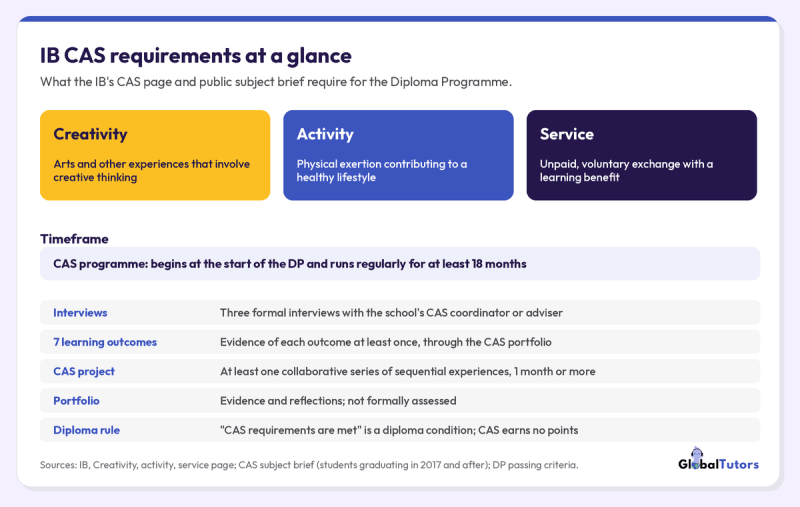
- Three strands: creativity, activity and service, with a reasonable balance between them.
- Timeframe: CAS formally begins at the start of the Diploma Programme and continues regularly for at least 18 months.
- CAS project: at least one collaborative CAS project lasting at least one month.
- Interviews: three formal interviews with the school's CAS coordinator or adviser.
- Learning outcomes: evidence of achieving each of the seven CAS learning outcomes at least once.
- Portfolio: a CAS portfolio of evidence and reflections, which is not formally assessed.
The chart below shows how these fit together.
Each requirement is explained in the sections below, starting with why CAS decides whether the diploma is awarded.
Why CAS matters for the diploma
The IB's diploma conditions start with "CAS requirements are met." The other conditions cover points and grades, such as at least 24 points in total.
CAS does not receive a grade, and completion is assessed by the school. The up to three core points in the diploma total come from theory of knowledge and the extended essay only, so CAS adds no points. A student with a high points total still does not receive the diploma if CAS is incomplete. Our guide to IB Diploma points explains the 45-point total and the other conditions.
The three CAS strands
The IB's CAS page characterises the strands as follows:
- Creativity: arts, and other experiences that involve creative thinking.
- Activity: physical exertion contributing to a healthy lifestyle, complementing academic work elsewhere in the DP.
- Service: an unpaid and voluntary exchange that has a learning benefit for the student, in which the rights, dignity and autonomy of all those involved are respected.
The IB notes that the strands are often interwoven with particular activities, so one experience can cover more than one strand.
What counts as a CAS experience
The subject brief defines a CAS experience as a specific event in which the student engages with one or more of the three strands. It can be a single event or an extended series of events. A CAS experience must:
- fit within one or more of the CAS strands
- be based on a personal interest, skill, talent or opportunity for growth
- provide opportunities to develop the attributes of the IB learner profile
- not be used or included in the student's DP course requirements.
That last rule matters: anything that is part of a DP course requirement cannot also count as a CAS experience. The brief also says a meaningful CAS programme must be more than just a series of unplanned or singular experiences.
The CAS project
Every student must be involved in at least one CAS project during the programme. The brief defines a CAS project as a collaborative series of sequential CAS experiences lasting at least one month. The IB says the project challenges students to show initiative, demonstrate perseverance, and develop skills such as collaboration, problem solving and decision making.
The brief's sample projects include a student group that plans, designs and creates a mural, and students who rehearse and perform a dance production for a community retirement home.
The seven CAS learning outcomes
Completion of CAS is based on achieving the seven learning outcomes. Through the CAS portfolio, students give the school evidence of having achieved each outcome at least once. The brief lists them as:
- Identify own strengths and develop areas for growth.
- Demonstrate that challenges have been undertaken, developing new skills in the process.
- Demonstrate how to initiate and plan a CAS experience.
- Show commitment to, and perseverance in, CAS experiences.
- Demonstrate the skills and recognize the benefits of working collaboratively.
- Demonstrate engagement with issues of global significance.
- Recognize and consider the ethics of choices and actions.
Some outcomes may be achieved many times and others less often. Each needs evidence at least once.
Reflection, interviews and the portfolio
Students reflect on their CAS experiences and keep a CAS portfolio as evidence of their engagement. The IB describes the portfolio as a collection of evidence that showcases CAS experiences and student reflections, and it is not formally assessed. Students also have three formal interviews with the school's CAS coordinator or adviser.
For service, the brief describes the typical stages as investigation, preparation and action that meets an identified need, reflection on significant experiences throughout, and demonstration, which allows for sharing what has taken place.
Does IB CAS have an hours requirement?
The IB's public CAS subject brief sets the timeframe (at least 18 months), the CAS project (at least one month) and the seven learning outcomes. It does not set a number of hours. Students also get guidance at school level, including the school's CAS handbook, information sessions and meetings.
How to plan CAS across the Diploma
- Start at the beginning of the DP. CAS runs for at least 18 months, so begin in the first term.
- Map experiences to outcomes. Keep a list of the seven outcomes and note which experience gives evidence for each.
- Plan the project early. It must be collaborative and last at least a month, so agree a team and a plan in good time.
- Reflect as you go. Write reflections soon after each significant experience, not at the end.
- Keep CAS separate from coursework. Choose experiences outside DP course requirements.
- Prepare for each interview. Bring your portfolio and be ready to discuss your progress on each outcome.
Our guides to the IB Diploma Programme and to theory of knowledge cover the rest of the DP core.
FAQ
Is CAS graded?
No. CAS does not receive a grade, and completion is assessed by the school.
Can you get the IB Diploma without CAS?
No. Meeting the CAS requirements is one of the conditions for the diploma.
How long does CAS last?
It formally begins at the start of the DP and continues regularly for at least 18 months.
How long must the CAS project be?
At least one month. It is a collaborative series of sequential CAS experiences.
Does CAS count towards the 45 points?
No. The up to three core points come from theory of knowledge and the extended essay.
Get help with the IB Diploma
Global Tutors works with families around the world on IB and Cambridge International courses. Of our 124 tutors, 16 have examiner, marker or moderator experience, and 51% hold a teaching qualification. Ask for a tutor with examiner, marker or moderator experience. We match you with a tutor within a day, starting with a free Meet & Greet, and there are no ongoing contracts.
Find an IB Diploma tutor | IB extended essay support | IB TOK tutoring
Sources
- IB, Creativity, activity, service: https://www.ibo.org/programmes/diploma-programme/curriculum/dp-core/creativity-activity-and-service/
- IB, CAS subject brief (for students graduating in 2017 and after): https://ibo.org/contentassets/5895a05412144fe890312bad52b17044/cas-2016-english-1st-final-web.pdf
- IB, DP passing criteria: https://www.ibo.org/about-the-ib/what-it-means-to-be-an-ib-student/recognizing-student-achievement/about-assessment/dp-passing-criteria/
Ready to excel in your exams?
Get personalized support from our expert tutors and achieve your academic goals.