IGCSE vs IB MYP: how the two compare at ages 14 to 16
Global TutorsOctober 28, 2026
Cambridge IGCSE and the IB Middle Years Programme (MYP) are both taken by students up to age 16, but they are different kinds of thing. Cambridge IGCSE is a qualification taken subject by subject, with assessment at the end of each course. The MYP is a five-year curriculum framework for ages 11 to 16, assessed mainly by teachers, with optional external assessment in the final year. This guide compares the two on structure, subjects, assessment, grading and certificates, so you can ask a school the right questions.
IGCSE vs IB MYP at a glance
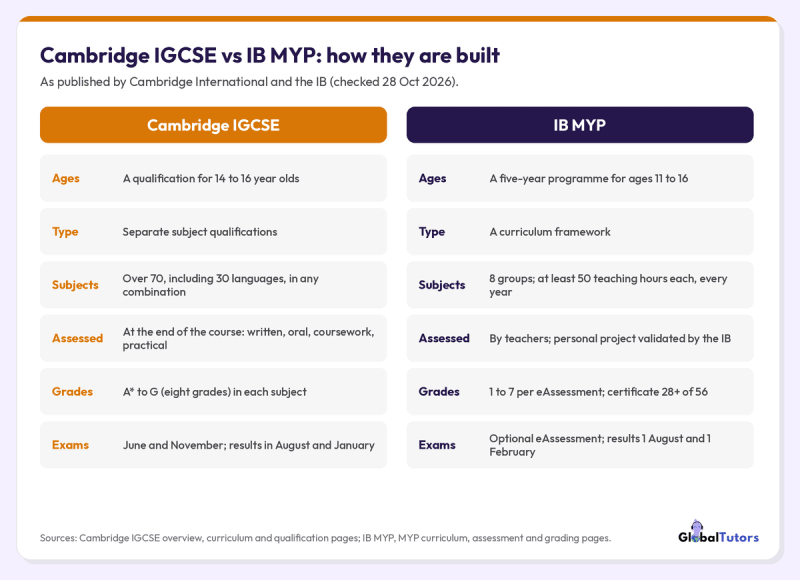
- Age range: Cambridge describes IGCSE as a qualification for 14 to 16 year olds. The MYP is for students aged 11 to 16.
- What it is: IGCSE is a set of subject qualifications. The MYP is a five-year programme, which can also run in two, three or four year formats.
- Subjects: over 70 IGCSE subjects, including 30 languages, which schools can offer in any combination. The MYP has eight subject groups.
- Assessment: IGCSE assessment takes place at the end of the course. MYP assessment is mainly school-based, marked by teachers against each subject group's criteria.
- Grades: Cambridge IGCSEs are graded A* to G around the world, on eight grades. MYP eAssessment results use grades from 1 to 7.
- Exam sessions: IGCSE exams run in June and November, with results in August and January. MYP eAssessment results come out on 1 August for May exams and 1 February for November exams.
The chart below sets the two side by side.
The sections below explain each difference in turn, starting with how each one is structured.
How Cambridge IGCSE works
Each IGCSE subject is its own qualification. Cambridge designs its IGCSE syllabuses to need about 130 guided learning hours for each subject. Schools choose which subjects to offer, from more than 70.
Assessment comes at the end of the course and can include written, oral, coursework and practical assessment. In many subjects there is a choice between Core and Extended curricula, which Cambridge says makes IGCSE suitable for a wide range of abilities. For how the grades and the Core and Extended routes work, see our guide to Cambridge IGCSE grading.
Cambridge publishes past papers, mark schemes, examiner reports and specimen papers for each subject on its IGCSE subject pages.
How the IB MYP works
The MYP is a framework rather than a set of exam syllabuses. Its eight subject groups are:
- language acquisition
- language and literature
- individuals and societies
- sciences
- mathematics
- arts
- physical and health education
- design.
The MYP requires at least 50 hours of teaching time for each subject group in each year. In years 4 and 5, students can take courses from six of the eight groups, within limits. Each year, students also complete at least one interdisciplinary unit involving at least two subject groups.
In the final year, every MYP student develops a personal project independently, and the IB externally validates it. Only schools authorised by the IB can offer the MYP.
Assessment: end-of-course exams vs teacher assessment
The two are assessed in different ways.
IGCSE: the grade in each subject is based on assessment at the end of the course, which can include written, oral, coursework and practical assessment.
MYP: teachers create and mark the assessment tasks, using each subject group's criteria in every year of the programme. External assessment is optional, apart from the personal project. If a school registers for MYP eAssessment, students can take:
- on-screen examinations, each lasting between 1 hour 45 minutes and 2 hours, marked by IB examiners
- ePortfolios of coursework, marked by teachers and moderated by the IB, including the compulsory personal project ePortfolio.
So whether an MYP student sits any external exams depends on the school. Our guide to MYP eAssessment explains the exams in more detail.
Grading and certificates
IGCSE: each subject is graded on its own, on the eight-grade A* to G scale.
MYP: students who take eAssessment receive IB MYP course results, showing each subject and its grade from 1 to 7, plus the personal project. The IB MYP certificate needs eight eAssessments: on-screen exams in language and literature, language acquisition, individuals and societies, sciences, mathematics and interdisciplinary learning, and ePortfolios in language acquisition, in physical and health education, arts or design, and the personal project.
The maximum certificate total is 56 points (8 × 7). To be eligible, a student needs at least 28 points, a grade 3 or higher in every eAssessment component, and to meet the school's requirements for service as action. A student with a 3 in all eight components has 24 points, which is 4 short of 28.
What comes after each
The IB says students who complete the MYP are well prepared to undertake the IB Diploma Programme or the Career-related Programme. Cambridge describes IGCSE as a springboard to advanced study. If your child is moving from IGCSE into the IB Diploma, read our guide to moving from IGCSE to IB. For the MYP route, see our guide to the MYP to Diploma transition.
Questions to ask a school
- Do you register students for MYP eAssessment, and in which subjects?
- Which IGCSE subjects do you offer, and at Core or Extended level?
- In which session will my child sit IGCSE exams, June or November?
- What do students take after age 16, and how does this programme lead into it?
FAQ
Is the MYP a qualification like IGCSE?
The MYP is a curriculum framework. Students who take eAssessment receive IB MYP course results, and those who meet the requirements receive the IB MYP certificate.
Does the MYP have final exams?
Only if the school registers for eAssessment. The personal project is the one compulsory external element.
How many subjects can you take at IGCSE?
Cambridge offers over 70 subjects, and schools can offer them in any combination. The subjects available depend on the school.
What age is the MYP for?
Students aged 11 to 16.
How is the MYP graded?
eAssessment results use grades from 1 to 7. The certificate needs at least 28 of 56 points and a grade 3 or higher in each component.
Get help with IGCSE or the MYP
Global Tutors works with families around the world on IB and Cambridge International courses. Of our 124 tutors, 16 have examiner, marker or moderator experience, and 51% hold a teaching qualification. Ask for a tutor with examiner, marker or moderator experience. We match you with a tutor within a day, starting with a free Meet & Greet, and there are no ongoing contracts.
Find an IGCSE tutor | IB MYP maths tutoring | IB MYP sciences tutoring
Sources
- Cambridge International, Cambridge IGCSE: https://www.cambridgeinternational.org/programmes-and-qualifications/cambridge-upper-secondary/cambridge-igcse/
- Cambridge International, Cambridge IGCSE curriculum: https://www.cambridgeinternational.org/programmes-and-qualifications/cambridge-upper-secondary/cambridge-igcse/curriculum/
- Cambridge International, Cambridge IGCSE qualification: https://www.cambridgeinternational.org/programmes-and-qualifications/cambridge-upper-secondary/cambridge-igcse/qualification/
- Cambridge International, IGCSE Mathematics 0580 syllabus for 2025, 2026 and 2027 (guided learning hours): https://www.cambridgeinternational.org/Images/662466-2025-2027-syllabus.pdf
- IB, Middle Years Programme: https://www.ibo.org/programmes/middle-years-programme/
- IB, MYP curriculum: https://www.ibo.org/programmes/middle-years-programme/curriculum/
- IB, MYP assessment and exams: https://www.ibo.org/programmes/middle-years-programme/assessment-and-exams/
- IB, MYP grading and awards: https://www.ibo.org/programmes/middle-years-programme/assessment-and-exams/grading-and-awards/
Related Cambridge tutoring
Find 1-to-1 tutoring for Cambridge IGCSE and A Level.
Ready to excel in your exams?
Get personalized support from our expert tutors and achieve your academic goals.