
AP Precalculus: units, exam format and what changes in 2027
Global TutorsOctober 23, 2026
AP Precalculus is College Board's precalculus course for high school students. Its function types run from polynomial, rational, exponential and logarithmic functions to trigonometric, polar and parametric functions, vectors and matrices, and the exam was first given in 2024. For the May 2027 exam, College Board has changed the number of multiple-choice questions and the timing of each section. This guide sets out the course, the exam and the 2027 changes using College Board's own pages.
What AP Precalculus covers
College Board describes the course as "designed to be the equivalent of a first semester college precalculus course". On its student page, the college course equivalent is "a college precalculus course or a college algebra with trigonometry course."
College Board organises the course into four units, listing topics that each unit may include:
- Unit 1: Polynomial and Rational Functions. Topics can include rates of change, end behaviour, asymptotes and holes in rational functions, and modelling with polynomial and rational functions.
- Unit 2: Exponential and Logarithmic Functions. Topics can include geometric sequences and exponential functions, composition and inverses, logarithmic models, and checking a model with a residual plot.
- Unit 3: Trigonometric and Polar Functions. Topics can include sine, cosine and tangent, sinusoidal models, inverse trigonometric functions, and polar graphs.
- Unit 4: Functions Involving Parameters, Vectors, and Matrices. Topics can include parametric functions, conic sections, vectors and transformation matrices.
Units 1, 2 and 3 are assessed on the AP Exam. Unit 4 is not assessed on the exam. College Board says it covers topics that teachers may include based on state or local requirements.
The course also builds three mathematical practices: procedural and symbolic fluency, multiple representations, and communication and reasoning.
Prerequisites for AP Precalculus
College Board recommends that students have completed introductory algebra and geometry courses before starting. Its student page lists the skills it expects, including:
- linear functions, polynomial addition and multiplication, and factoring quadratic trinomials
- the quadratic formula, and solving linear and quadratic equations and inequalities
- right triangle trigonometry
- systems of equations in two and three variables
- familiarity with piecewise-defined functions, exponential functions and rules for exponents, radicals and complex numbers
If any of these feel shaky, work on them before the course starts or during its first weeks.
The AP Precalculus exam format from May 2027
The exam is 2 hours and 55 minutes long. It's a hybrid digital exam: students answer the multiple-choice questions and read the free-response questions in the Bluebook app, then handwrite their free-response answers in a paper booklet.
- Section I, Part A: 29 multiple-choice questions in 65 minutes, no calculator, 43.75% of the exam score.
- Section I, Part B: 13 multiple-choice questions in 40 minutes, graphing calculator required, 18.75%.
- Section II, Part A: 2 free-response questions in 35 minutes, graphing calculator required, 18.75%.
- Section II, Part B: 2 free-response questions in 35 minutes, no calculator, 18.75%.
That makes 42 multiple-choice questions worth 62.5% and 4 free-response questions worth 37.5%. Each free-response question is worth 6 points, and the four are weighted equally. College Board lists the four questions as:
- Question 1: Function Concepts (graphing calculator)
- Question 2: Modeling a Non-Periodic Context (graphing calculator)
- Question 3: Modeling a Periodic Context (no calculator)
- Question 4: Symbolic Manipulations (no calculator)
Two of the four questions incorporate a real-world function modelling context.
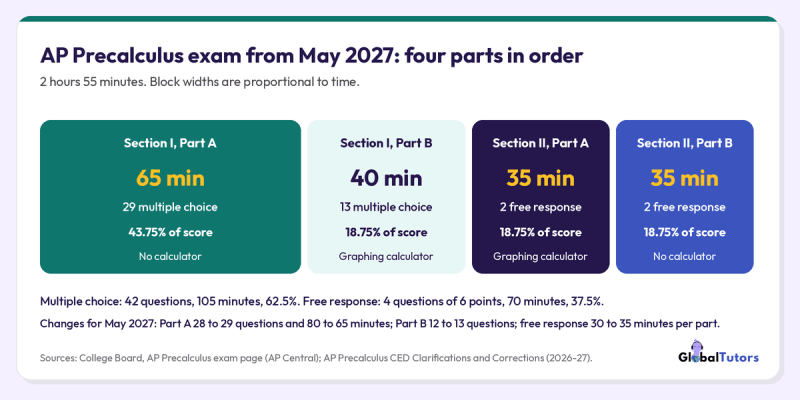 The chart shows the four parts of the exam in order, with their timing and share of the score.
What changed for 2027
College Board's clarifications document for the 2026-27 school year lists these exam changes, effective from the May 2027 exam:
- Multiple-choice Part A went from 28 to 29 questions, and from 80 to 65 minutes.
- Multiple-choice Part B went from 12 to 13 questions.
- Both free-response parts went from 30 to 35 minutes, and the structure of Question 2 was updated.
College Board also says the course content hasn't changed. Based on the changes it lists, the exam is 15 minutes shorter than before: 175 minutes against 180. In Part A, the time per question falls from about 2 minutes 51 seconds to about 2 minutes 14 seconds. If your teacher sets practice tests from earlier years, time them to the 2027 format.
Calculators on the AP Precalculus exam
A graphing calculator is required for Part B of the multiple-choice section and Part A of the free-response section. The other two parts don't allow a calculator. A built-in Desmos graphing calculator is available in Bluebook, but only in the calculator-required parts. Students may also bring up to 2 permitted handheld calculators. College Board's student exam page specifies radian mode for both calculator parts.
College Board lists what a graphing calculator for AP Precalculus must be able to do, including graphing functions, finding real zeros, intersections, and minima and maxima, solving equations in one variable numerically, and finding regression equations (linear, quadratic, cubic, quartic, exponential, logarithmic and sinusoidal) and plotting residuals. Its approved list includes models from Casio, NumWorks and Texas Instruments. The web and app versions of Desmos can be used during the school year, but only the built-in Desmos in Bluebook can be used in the exam.
College Board also states that technology should not replace symbolic manipulation skills: "Most of the AP Exam will need to be completed without the use of technology."
A worked example: residuals
Unit 2 uses residuals to check a model. College Board defines a residual as the actual value of the dependent variable minus the value predicted by the regression model.
Suppose a model predicts 11.9 and the actual value is 12.4. The residual is 12.4 - 11.9 = 0.5. Because it's positive, the actual value is above the prediction, so the model underestimates at that point. A second point with actual value 8.1 and predicted value 8.6 has a residual of -0.5, an overestimate. College Board says a model is justified as appropriate if the residual plot appears without pattern.
Scores, fees and dates
AP Exams are scored from 1 to 5. In 2026, College Board reports that 29% of AP Precalculus students scored 5, 29% scored 4 and 24% scored 3, so 82% scored 3 or higher.
For 2026-27, the exam fee is $99 per exam at schools in the US, US territories and Canada, and $129 at schools elsewhere. The on-time ordering deadline is November 13, 2026, for full-year and first-semester courses, and a $40 late order fee applies to exams ordered from November 14, 2026, to March 12, 2027. The 2027 AP Precalculus exam is on Tuesday, May 11, 2027, in Session 1.
How to prepare
- Learn the no-calculator skills first. Parts A of Section I and B of Section II don't allow a calculator.
- Practise the four free-response question types. College Board posts past free-response questions and scoring guidelines on AP Central.
- Use Bluebook test previews so the hybrid format is familiar before exam day.
- Choose one calculator from the approved list or Desmos and use it all year.
Our AP tutoring hub covers every AP course we support. If precalculus leads on to calculus, read AP Calc AB vs BC and see the full AP exam dates for 2027.
FAQ
Is AP Precalculus on the 2027 AP exam schedule?
Yes. The exam is on Tuesday, May 11, 2027, in Session 1.
How long is the AP Precalculus exam?
2 hours and 55 minutes from May 2027: 105 minutes of multiple choice and 70 minutes of free response.
Is Unit 4 on the AP Precalculus exam?
No. Units 1, 2 and 3 are assessed. Unit 4 is not assessed on the AP Exam.
Can I use a calculator on the whole exam?
No. A graphing calculator is required in Section I Part B and Section II Part A. The other two parts don't allow a calculator.
What college course does AP Precalculus match?
College Board gives the equivalent as a college precalculus course or a college algebra with trigonometry course.
Prepare for AP exams with a tutor
Our 124 tutors include 16 with examiner, marker or moderator experience, and 51% hold a teaching qualification. We'll match you with a tutor within a day, starting with a free, no-obligation Meet & Greet. There are no long-term contracts.
Find an AP tutor | AP Calculus AB tutoring | Tutoring in the United States
Sources
- College Board, AP Precalculus (AP Students course page): https://apstudents.collegeboard.org/courses/ap-precalculus
- College Board, AP Precalculus exam (AP Students): https://apstudents.collegeboard.org/courses/ap-precalculus/assessment
- College Board, AP Precalculus course (AP Central): https://apcentral.collegeboard.org/courses/ap-precalculus
- College Board, AP Precalculus exam (AP Central): https://apcentral.collegeboard.org/courses/ap-precalculus/exam
- College Board, AP Precalculus Course Overview: https://apcentral.collegeboard.org/media/pdf/ap-precalculus-course-overview.pdf
- College Board, AP Precalculus Course and Exam Description: https://apcentral.collegeboard.org/media/pdf/ap-precalculus-course-and-exam-description.pdf
- College Board, AP Precalculus CED Clarifications and Corrections: https://apcentral.collegeboard.org/media/pdf/ap-precalculus-ced-clarification-and-guidance.pdf
- College Board, Graphing Calculators for AP Precalculus: https://apcentral.collegeboard.org/courses/ap-precalculus/exam/graphing-calculators
- College Board, AP Exams Calculator Policy: https://apstudents.collegeboard.org/exam-policies-guidelines/calculator-policies
- College Board, AP Precalculus Free-Response Questions: https://apcentral.collegeboard.org/courses/ap-precalculus/exam/past-exam-questions
- College Board, AP Precalculus Score Distributions: https://apstudents.collegeboard.org/about-ap-scores/score-distributions/ap-precalculus
- College Board, AP Exam Fees: https://apcentral.collegeboard.org/exam-administration-ordering-scores/ordering-fees/exam-fees
- College Board, 2027 AP Exam Dates: https://apcentral.collegeboard.org/exam-administration-ordering-scores/exam-dates
Ready to excel in your exams?
Get personalized support from our expert tutors and achieve your academic goals.