IB HL vs SL: what changes between the two levels
Global TutorsOctober 27, 2026
Every IB Diploma student takes some subjects at higher level (HL) and the rest at standard level (SL). The two levels share the same grade scale, but HL covers more content, takes more teaching time and can have longer or extra exams. This guide explains the rules on HL and SL, shows how the levels differ in two subjects using the IB's own subject briefs, and sets out questions to help your child choose their HL subjects.
The rules on HL and SL
The IB sets these rules for the Diploma Programme:
- Each student takes a minimum of three and a maximum of four subjects at HL, and the rest at SL.
- SL subjects take up 150 teaching hours, and HL subjects 240.
- HL and SL differ in scope but are measured against the same grade descriptors. HL students are expected to show a greater body of knowledge, understanding and skills.
- The IB awards the same points for HL and SL: each subject is graded 7 to 1.
So a 6 at SL and a 6 at HL each add 6 points to the diploma total. The levels still matter for the award, though. Among the conditions for the diploma, a student needs at least 12 points on HL subjects (for students registered for four HL subjects, the three highest grades count) and at least 9 points on SL subjects. Our guide to IB Diploma points explains every condition with worked examples.
IB HL vs SL in practice: two subject examples
The differences depend on the subject. The IB's subject briefs show them clearly.
Biology (first assessment 2025). The syllabus content takes 110 recommended hours at SL and 180 at HL, and the experimental programme 40 at SL and 60 at HL. Some topics, such as viruses, origins of cells and classification and cladistics, include content that the IB says should only be taught to HL students. Both levels sit the same two papers with the same weightings, but HL papers are longer:
- Paper 1 (multiple-choice and data-based questions): 1.5 hours at SL, 2 hours at HL, 36% at both levels.
- Paper 2 (data-based, short-answer and extended-response questions): 1.5 hours at SL, 2.5 hours at HL, 44% at both levels.
- Scientific investigation (internal assessment): 10 hours at both levels, a written report of up to 3,000 words, 20% at both levels.
Economics (first assessment 2022). Here HL adds a whole exam:
- SL: Paper 1 (extended response, 1 hour 15 minutes, 30%), Paper 2 (data response, 1 hour 45 minutes, 40%) and the internal assessment portfolio of three commentaries (30%). Exams total 3 hours.
- HL: Paper 1 (1 hour 15 minutes, 20%), Paper 2 (1 hour 45 minutes, 30%), Paper 3 (a policy paper, 1 hour 45 minutes, 30%) and the same portfolio (20%). Exams total 4 hours 45 minutes.
HL economics also adds microeconomics topics on asymmetric information, market power and the market's inability to achieve equity. The chart below compares the exam time at each level.
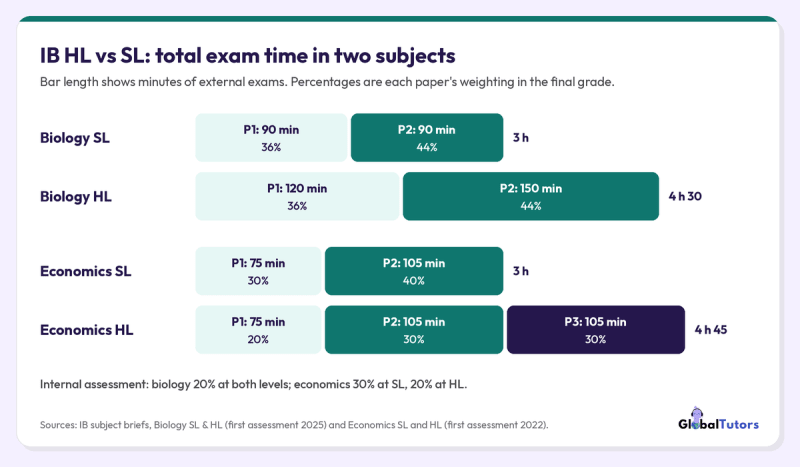
The internal assessment weighting differs too: 30% at SL and 20% at HL in economics, but 20% at both levels in biology. Read the brief for each subject your child is considering.
How universities look at HL
Universities set their own policies, and some treat HL and SL differently. The University of California, for example, awards units for individual Higher Level exams: students with IB certificates who score 5, 6 or 7 on HL exams receive 8 quarter units per exam. If your child has target universities in mind, read their published IB policies before choosing HL subjects, especially for subjects linked to their intended major.
How to choose HL subjects
Work through these questions together:
- Which subjects does your child want to study at university? Put the subjects most closely linked to that plan at HL.
- Which subjects can they sustain for 240 hours? HL is 90 more teaching hours than SL in each subject.
- How do the exams change? Compare the SL and HL assessment in each subject brief: longer papers, an extra paper or different weightings.
- Is three HL or four HL right? Three is the minimum. With four, the three highest HL grades count towards the 12-point HL condition.
- Which maths course and level fit? Our guide to IB Math AA vs AI covers the course choice, including what changes from 2027.
- What does the school offer? Check which subjects the school runs at each level and how they fit the timetable.
If your child is moving from IGCSE, our guide to IGCSE to IB explains the wider transition, and our IB hub covers each part of the programme.
FAQ
What is the difference between HL and SL in the IB?
HL takes 240 teaching hours and SL 150. HL covers more content and is assessed against the same grade descriptors, with students expected to show a greater body of knowledge, understanding and skills.
How many HL subjects do you need for the IB Diploma?
At least three and no more than four. The rest are taken at SL.
Is an HL 7 worth more points than an SL 7?
No. The IB awards the same points at both levels. The diploma does require at least 12 points across HL subjects and at least 9 across SL subjects.
Do HL exams take longer?
In both subjects in this guide, yes. In biology, HL exams total 4.5 hours against 3 at SL. In economics, HL adds a third paper, for 4 hours 45 minutes against 3 hours at SL.
Can you take four HL subjects?
Yes, four is the maximum. For students registered for four HL subjects, the three highest HL grades count towards the 12-point HL condition.
Get help with HL subjects
Our 124 tutors include 16 with examiner, marker or moderator experience, and 51% hold a teaching qualification. Ask for a tutor with examiner, marker or moderator experience. We'll match you with a tutor within a day, starting with a free Meet & Greet, and there are no ongoing contracts.
Find an IB Diploma tutor | IB Biology tutoring | IB Economics tutoring
Sources
- IB, DP curriculum (HL and SL rules, teaching hours): https://www.ibo.org/programmes/diploma-programme/curriculum/
- IB, Understanding DP assessment: https://www.ibo.org/programmes/diploma-programme/assessment-and-exams/understanding-ib-assessment/
- IB, DP passing criteria: https://www.ibo.org/about-the-ib/what-it-means-to-be-an-ib-student/recognizing-student-achievement/about-assessment/dp-passing-criteria/
- IB, Biology subject brief (SL and HL, first assessment 2025): https://ibo.org/globalassets/new-structure/recognition/pdfs/dp_sciences_biology_subject-brief_jan_2022_e.pdf
- IB, Biology in the DP: https://www.ibo.org/programmes/diploma-programme/curriculum/sciences/biology/
- IB, Economics subject brief, SL: https://ibo.org/globalassets/new-structure/programmes/dp/pdfs/sl-economics-en.pdf
- IB, Economics subject brief, HL: https://ibo.org/globalassets/new-structure/programmes/dp/pdfs/hl-economics-en.pdf
- IB, Economics in the DP: https://www.ibo.org/programmes/diploma-programme/curriculum/individuals-and-societies/economics/
- University of California, IB credits: https://admission.universityofcalifornia.edu/admission-requirements/ap-exam-credits/ib-credits.html
Ready to excel in your exams?
Get personalized support from our expert tutors and achieve your academic goals.