AICE vs IB: how the two diplomas compare
Global TutorsOctober 27, 2026
The Cambridge AICE Diploma and the IB Diploma are both international upper-secondary diplomas, but they are built differently. The IB Diploma is a two-year program of six subjects plus a core. The AICE Diploma is a group award made up of Cambridge International AS & A Level exams that a student can build up over several exam series. This guide sets out the differences in structure, assessment, grading and US college credit, with questions to help your family choose.
AICE vs IB at a glance
- Who awards it: AICE is awarded by Cambridge International; the IB Diploma by the International Baccalaureate.
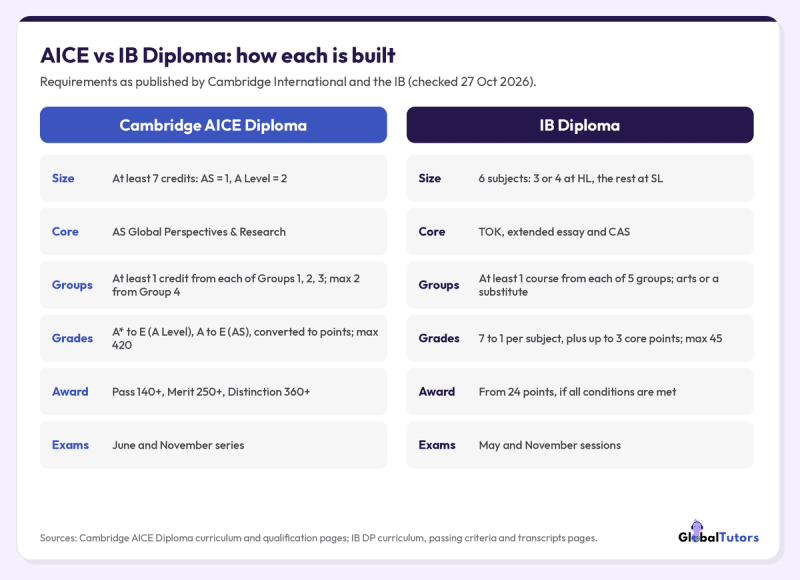
- What it is made of: AICE is at least seven credits of Cambridge International AS & A Level exams, including Global Perspectives & Research. The IB Diploma is six subjects plus theory of knowledge (TOK), the extended essay (EE) and creativity, activity, service (CAS).
- Levels: In AICE, an AS Level earns one credit and an A Level two. In the IB, each student takes three or four subjects at higher level (HL) and the rest at standard level (SL).
- Grading: AICE uses A* to E at A Level and A to E at AS Level, converted to diploma points. The IB grades each subject from 7 to 1, for a maximum of 45 points.
- Exams: AICE exams run in June and November. The IB runs two exam sessions a year, in May and November.
The chart below shows the two structures side by side.
Both diplomas are built from individual subject results. A student who misses the diploma still has a result for each subject: a grade for each IB course attempted, or a certificate for each Cambridge subject.
Structure: subject groups and the core
AICE. Students study the compulsory core subject, Cambridge International AS Level Global Perspectives & Research (9239), with AS and A Level subjects from three groups: mathematics and sciences (Group 1), languages (Group 2) and arts and humanities (Group 3). Interdisciplinary subjects form an optional Group 4. A student needs at least one credit from each of Groups 1, 2 and 3, and no more than two credits can count from Group 4. Cambridge lists over 50 AS and A Level subjects across the four groups. Global Perspectives & Research is assessed through a team project and presentation as well as a written exam.
IB. Students choose subjects from six groups: studies in language and literature, language acquisition, individuals and societies, sciences, mathematics and the arts. They must take at least one course from each of the first five, and may take an additional sciences, individuals and societies, or languages subject instead of an arts subject. The core is compulsory: TOK is assessed through an exhibition and a 1,600-word essay, the EE is an independent research project finishing with a 4,000-word paper, and CAS is completed alongside the academic subjects.
Depth and workload
The IB sets 240 teaching hours for each HL subject and 150 for each SL subject. Cambridge designs its AS & A Level syllabuses to require about 180 guided learning hours for an AS Level and about 360 for an A Level.
In AICE, the mix of AS and A Levels is flexible. Cambridge lists four valid combinations for seven credits, from three A Levels plus the core to six AS Levels plus the core. In the IB, every student takes six subjects in the two-year program, with three or four of them at HL.
Exams and timing
AICE. Cambridge holds AS & A Level exam series in June and November, with results in August and January. Cambridge describes the AS Level as typically a one-year course and the A Level as typically a two-year course. A student can take an A Level in one series at the end of the course, or in stages, with the AS in one series and the rest of the A Level in a later one. Results for the diploma can be built up over up to five exam series within a 25-month period, and the student is entered for the diploma in the final series.
IB. The IB holds two exam sessions a year. Results for the May session are issued on 5 July, and for the November session on 16 December. For most courses, written exams at the end of the DP form the basis of the assessment. The TOK essay and the EE are externally assessed coursework, and in most subjects students also complete in-school assessment tasks.
Grading and how the diploma is awarded
AICE. Each grade converts to points. At A Level, A* earns 140, A 120, B 100, C 80, D 60 and E 40. At AS Level, A earns 60, B 50, C 40, D 30 and E 20. The total is capped at 420. The diploma is awarded with Distinction at 360 points or above, with Merit at 250 to 359, and at Pass level at 140 to 249. Students who don't meet the requirements receive certificates for their individual subjects.
IB. The diploma score is the six subject grades plus up to 3 points from TOK and the EE, for a maximum of 45. The diploma is awarded from 24 points, provided the student meets the other conditions, including at least 12 points on HL subjects, at least 9 points on SL subjects, and completed CAS. Our guide to IB Diploma points explains each condition.
AICE vs IB for US college credit
Credit policies are set by each university. The University of Florida, for example, publishes rules for both:
- AICE: credit for approved AICE exams with scores of A to E: 3 credits per AS Level exam and 6 per A Level exam, unless otherwise noted in UF's chart.
- IB: credit for scores of 4 or higher on both HL and SL exams.
- Both: if duplicate credit exists among AICE, AP, CLEP or IB, the exam yielding the most credit is awarded, and credit by exam is capped at 45 credits across the programs combined.
For other colleges, read each university's published policy for both programs. Our guide to IB vs AP compares the IB with another US-recognized program.
How to choose between AICE and IB
Work through these questions together:
- Does your child want a set program or a flexible one? The IB sets six subjects plus the core of TOK, the EE and CAS. AICE lets a student combine AS and A Levels and build credits over several series.
- How does your child feel about the core? Compare Global Perspectives & Research with TOK, the EE and CAS.
- Which subjects does your child want to study in depth? In the IB, that means choosing three or four HL subjects. In AICE, it means choosing which subjects to take to full A Level.
- What do the target universities publish? Check admission and credit policies for both programs.
- What does the school offer? Ask which subjects and exam series the school offers.
If your child is coming from IGCSE, our guide to moving from IGCSE to IB explains what changes.
FAQ
Is AICE or IB harder?
They ask for different things: the IB requires six subjects, three or four at HL, plus TOK, the EE and CAS. AICE requires seven credits from AS and A Levels across set groups, including Global Perspectives & Research.
How many subjects are in AICE?
It depends on the mix. Seven credits can come from three A Levels plus Global Perspectives & Research, or from up to six AS Levels plus Global Perspectives & Research.
When are the exams?
AICE exams run in June and November. IB exams run in May and November sessions.
Get support for AICE or the IB
Our 124 tutors include 16 with examiner, marker or moderator experience, and 51% hold a teaching qualification. Ask for a tutor with examiner, marker or moderator experience. We'll match you with a tutor within a day, starting with a free Meet & Greet, and there are no ongoing contracts.
Find an IB Diploma tutor | Cambridge AS Level tutoring | Tutoring in the United States
Sources
- Cambridge International, Cambridge AICE Diploma: https://www.cambridgeinternational.org/programmes-and-qualifications/cambridge-advanced/cambridge-aice-diploma/
- Cambridge International, Cambridge AICE Diploma curriculum: https://www.cambridgeinternational.org/programmes-and-qualifications/cambridge-advanced/cambridge-aice-diploma/curriculum/
- Cambridge International, Cambridge AICE Diploma qualification (credits, points, exam series): https://www.cambridgeinternational.org/programmes-and-qualifications/cambridge-advanced/cambridge-aice-diploma/qualification/
- Cambridge International, AS & A Level Mathematics 9709 syllabus for 2026 and 2027 (guided learning hours): https://www.cambridgeinternational.org/Images/697427-2026-2027-syllabus.pdf
- IB, Biology subject brief (the DP as a two-year course): https://ibo.org/globalassets/new-structure/recognition/pdfs/dp_sciences_biology_subject-brief_jan_2022_e.pdf
- IB, DP curriculum: https://www.ibo.org/programmes/diploma-programme/curriculum/
- IB, DP passing criteria: https://www.ibo.org/about-the-ib/what-it-means-to-be-an-ib-student/recognizing-student-achievement/about-assessment/dp-passing-criteria/
- IB, Understanding DP assessment: https://www.ibo.org/programmes/diploma-programme/assessment-and-exams/understanding-ib-assessment/
- IB, Theory of knowledge: https://www.ibo.org/programmes/diploma-programme/curriculum/dp-core/theory-of-knowledge/
- IB, Extended essay: https://www.ibo.org/programmes/diploma-programme/curriculum/dp-core/extended-essay/
- IB, Receive and evaluate IB transcripts (exam sessions and results dates): https://www.ibo.org/university-admission/universities-collaborate-with-the-ib/receive-and-evaluate-ib-transcripts2/
- University of Florida, Exam Credit: https://catalog.ufl.edu/UGRD/academic-advising/exam-credit/
Related Cambridge tutoring
Find 1-to-1 tutoring for Cambridge IGCSE and A Level.
Ready to excel in your exams?
Get personalized support from our expert tutors and achieve your academic goals.